
New Labour Codes: Will Your In-Hand Salary Drop?
By CA Aditya Pratap Singh | Last updated: 18 October 2026
Your HR sent a mail about a “revised salary structure” and now everyone in the office is asking the same thing: will my take-home go down? Short answer: the new labour codes don’t cut your salary by themselves, but they can change how your CTC is split, and that changes your PF, gratuity and in-hand amount. नया लेबर कोड सैलरी पर असर तभी डालता है जब कंपनी स्ट्रक्चर बदले।
Table of Contents
Toggle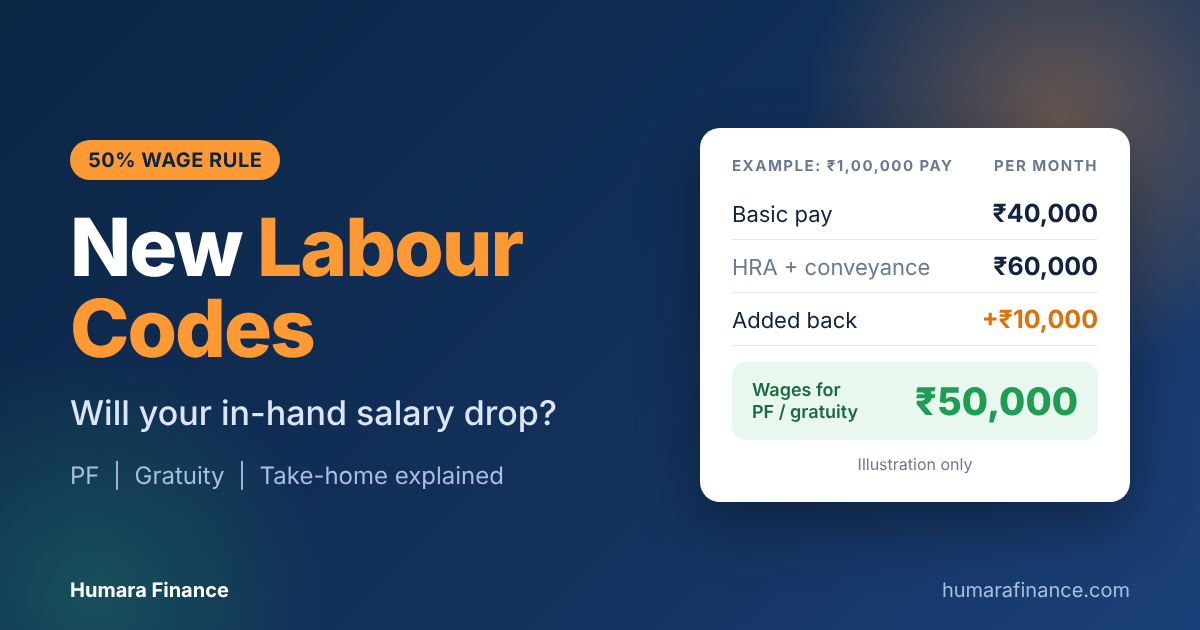
What changed and when
The four labour codes came into force on 21 November 2025. The one that matters for your salary slip is the Code on Wages. The Central rules for it were notified on 8 May 2026. State rules are still arriving, so some employers are waiting for their state before they change anything.
The 50% wage rule, in plain words
The codes define “wages” as basic pay plus dearness allowance plus retaining allowance. Things like HRA, conveyance, your employer’s PF contribution and gratuity are excluded. But there’s a limit. If these excluded items add up to more than 50% of your total pay, the extra gets added back to your wages.
Here’s the part most people get wrong. The rule does not say your basic must be 50% of CTC. It only caps how much can sit outside “wages”. In many salary structures it never kicks in.
Illustration with a ₹1,00,000 monthly salary (simplified):
- Basic pay: ₹40,000
- HRA: ₹40,000
- Conveyance: ₹20,000
HRA and conveyance together are ₹60,000, which is above half of ₹1,00,000. The excess ₹10,000 gets added back, so wages become ₹40,000 + ₹10,000 = ₹50,000.
Where your money is affected
| Item | What happens |
|---|---|
| PF | The employee and employer each pay 12%, and the ₹15,000 wage ceiling was reaffirmed in May 2026. How the new wage definition works with the ceiling is not settled, so ask your payroll team before assuming anything. |
| Gratuity | It’s calculated on wages, so a higher wage base means a bigger payout. |
| Take-home | It changes only if your employer restructures your salary. The codes don’t change your tax. |
The gratuity example. The formula is last drawn wages × 15/26 × years of service. Say you’ve served 5 years:
- On wages of ₹30,000: 30,000 × 15/26 × 5 = about ₹86,538
- On wages of ₹50,000: 50,000 × 15/26 × 5 = about ₹1,44,231
That’s roughly ₹57,000 more, with no change in your salary. This only applies if your employer used a smaller base earlier. Whether the new base applies to service before November 2025 is still being read differently by experts, so check with your HR.
The PF example. If your PF is already calculated on your full wages (not capped at ₹15,000) and your basic goes up by ₹10,000, your PF deduction rises by ₹1,200 a month. Your in-hand falls by that amount, but the money still belongs to you, in your PF account.
Gratuity after one year
Regular employees still generally need 5 years of service. The one-year rule applies to fixed-term employees hired under a written contract for a fixed period. An 11-month contract won’t qualify. Gig workers and contract workers supplied by an agency don’t get it automatically.
Mistakes I see people make
Most people assume that “basic = 50% of CTC” is now the law. It isn’t. Another common one is assuming a lower take-home means a pay cut. If basic goes up and in-hand goes down, check where the difference went. It usually went into PF and gratuity, which is saving, not loss.
One thing most people miss: if you’re on the old tax regime, a higher basic can increase your HRA exemption, because the exemption is worked out from basic. In the new regime there’s no HRA exemption, so the gain doesn’t apply.
What I’d do
Don’t react to the news. Wait for your company’s revised structure, then ask HR three things: what’s my new basic, is my PF now on a higher base, and how is my gratuity going to be calculated? Compare old vs new in-hand and also old vs new PF plus gratuity. Judge by the total, not just the monthly credit.
If your employer hasn’t said anything yet, that can be normal. State rules are still coming and many companies are waiting.
FAQs
Is basic pay now 50% of CTC?
No. The 50% limit applies to the excluded components. It’s not a minimum for basic pay.
Will my take-home salary fall?
Only if your employer restructures your pay. The codes don’t change your tax, but they can increase PF deductions.
When did the new labour codes start?
On 21 November 2025. The Central Code on Wages rules followed on 8 May 2026.
Is gratuity payable after 1 year now?
Only for fixed-term employees. Regular employees generally need 5 years.
Do state rules matter?
Yes, because labour is a shared subject. Your employer may be waiting on its state’s notification.
This is for educational purposes only, not financial advice. Check your employer’s communication and the official notifications before acting.