
Gold Explained: Price History, What Moves It and Should You Invest?
By Humara Finance | Last updated: 22 November 2026
Table of Contents
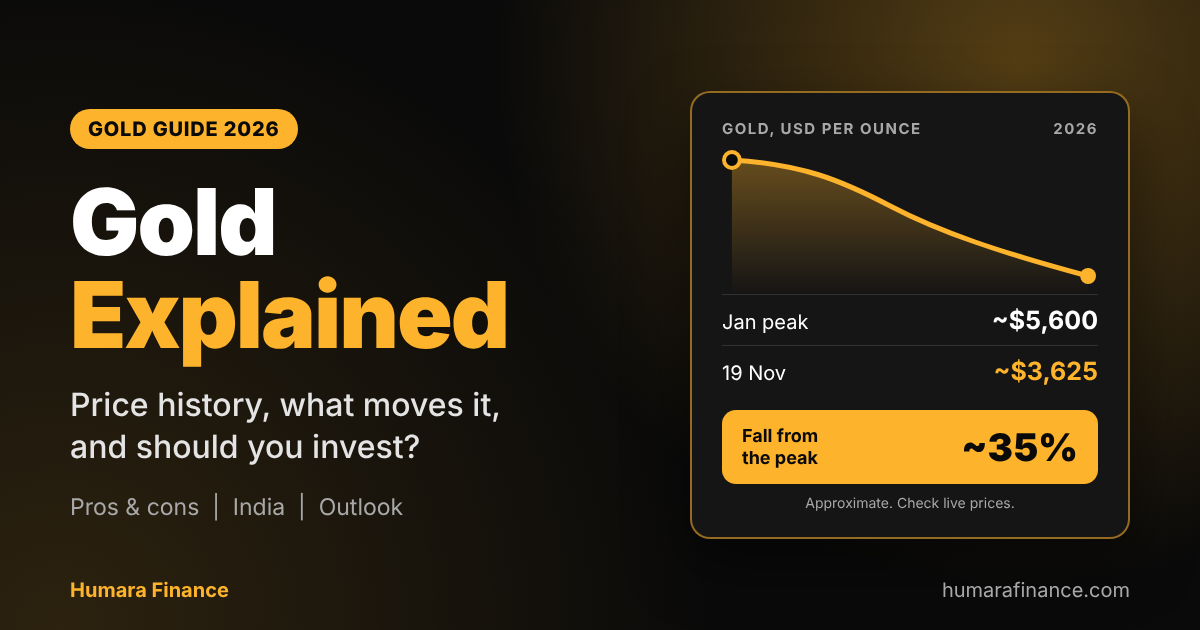
ToggleIn January 2026, gold touched nearly $5,600 an ounce. By 19 November it was around $3,625, a fall of about 35% in ten months. In India, the Prime Minister has said his appeal to skip gold helped prices drop. Both things can’t be fully true, and that’s why gold confuses people. This guide puts the history, the drivers, the risks and the outlook in one place. Gold ka sach, seedhi baat.
A quick snapshot (as of 19-21 November 2026)
- Global spot gold: about $3,625 per ounce on 19 November, its lowest in about 14 months.
- India, 24K: about ₹1.42 lakh per 10 g on 7 November and about ₹1.33 lakh by 18 November. By 21 November, 22K was around ₹1,12,000 in Mumbai.
- India’s import duty on gold is 15% since 13 May 2026, up from 6%.
Prices change daily, so check a live rate before you buy or sell.
Gold price history: from ₹63 to over ₹1 lakh
| Year | India, per 10 g (approx. annual average) |
|---|---|
| 1964 | ₹63 |
| 1970 | ₹184 |
| 1980 | ₹1,330 |
| 1990 | ₹3,200 |
| 2000 | ₹4,400 |
| 2010 | ₹18,500 |
| 2020 | about ₹48,000 |
| Nov 2025 | about ₹1.24 lakh |
| 2026 | roughly ₹1.3 to ₹1.5 lakh before the November fall |
Sources disagree by a few percent for some years, so treat the table as a guide. By my calculation, ₹63 in 1964 to about ₹1.33 lakh now works out to roughly 13% a year.
The story behind the numbers:
- 1971: The US ended the link between the dollar and gold, which had fixed gold at $35 an ounce. Gold has floated freely since.
- 1980 to 2000: The dry spell. The dollar price closed 1980 at about $590 and 2000 at about $273, which is 20 years of going nowhere. Indian buyers didn’t feel it as badly because the rupee kept weakening, and ₹1,330 became ₹4,400.
- 1991: India pledged 67 tonnes of gold to raise money during its balance of payments crisis. Gold then became part of the reform story, and imports were gradually opened up.
- 2008 to 2011: The financial crisis pushed investors to gold. Global prices passed $1,400 by 2010.
- 2020: The pandemic and cheap money sent prices to fresh highs.
- 2025: Gold crossed $4,000 for the first time in October, after rising more than 50% in the year.
What moves the price of gold
| Driver | How it works |
|---|---|
| US interest rates | Gold pays no interest. When rates and bond yields rise, holding gold costs more in missed income, so prices tend to fall. |
| The US dollar | Gold is priced in dollars. A stronger dollar makes it costlier for the rest of the world. |
| Central banks | They’ve been big buyers. Goldman Sachs expects about 60 tonnes a month, against about 17 tonnes a month before 2022. |
| Fear and geopolitics | Wars and crises raise safe-haven demand. |
| Inflation | Over long periods, gold has kept pace with rising prices. |
| Investor flows | Money moving in and out of gold ETFs can push prices sharply. |
| India’s local factors | The rupee, import duty and festival and wedding demand. |
A simple example of how India’s price is built. Take global gold at $3,625.50 an ounce. One ounce is 31.1035 grams, so 10 g costs about $1,166. Assume ₹90 to the dollar (an illustration, not today’s rate): that’s about ₹1,04,900. Add 15% import duty and 3% GST and you get about ₹1,24,300. With the old 6% duty, it would be about ₹1,14,500. Duty alone adds close to ₹9,700 per 10 g in this example. Real prices differ because of premiums, discounts and the actual rupee rate.
Why gold fell in November 2026
The main cause is the US Federal Reserve. It has been raising rates, and the market expected another 25 basis point hike at the 8 to 9 December meeting. The dollar index reached its highest in about 19 months (near 103.7), and the 10-year US yield was near 5.1%. Those are the exact conditions that hurt gold. Broad selling across commodities and stocks made it worse.
India's side of the story
India is one of the world’s biggest gold buyers, and in 2026 the government has tried to cut imports:
- Import duty: raised from 6% to 15% effective 13 May 2026. The World Gold Council called it the steepest increase on record, and it reversed the July 2024 cut.
- Demand: India’s gold demand in July to September fell 29% from a year earlier to 162.5 tonnes. The council expects full-year 2026 demand of 625 to 675 tonnes.
- The grey market: Unofficial imports jumped to about 50 tonnes in the quarter, from about 3 tonnes a year earlier. Official imports fell about 70%. Higher duty tends to push buyers toward smuggling.
- Domestic prices: Indian prices traded at an average $43 an ounce below import parity in the quarter, the highest discount on record.
The PM's appeal: did it move prices?
In May 2026, the Prime Minister asked Indians not to buy gold for a year, saying the country’s foreign exchange reserves were under pressure from high oil prices and the Iran conflict. India imported about $72 billion of gold in FY26, a record. He repeated the appeal on 1 September, and on 21 November in Lucknow said people bought less and prices fell.
What the evidence shows:
- The global price didn’t react much in May, and analysts said the appeal wouldn’t change India’s long-term appetite for gold.
- Jewellery stocks fell 5% to 12% when the appeal came.
- The World Gold Council blamed July to September’s weak demand on a high base, affordability, the festival calendar and delayed imports. It didn’t name the appeal. A PTI report listed the appeal among possible causes.
My reading: the appeal and the duty hike probably cut Indian demand and pushed some buying underground. But the global price is set mainly by US rates and the dollar, and a one-year pledge by Indian households isn’t big enough to explain a 35% fall.
Pros and cons of investing in gold
Pros
- It has held its value over very long periods and kept pace with inflation.
- It tends to hold up when stocks fall in a crisis, so it diversifies a portfolio.
- It’s easy to sell, and it’s a cultural comfort asset.
- A weak rupee boosts the rupee price of gold.
Cons
- It pays no income, so there’s no interest or dividend.
- It can be very volatile. A 35% fall in ten months is not rare, and 1980 to 2000 shows it can stall for decades.
- Physical gold has costs: making charges, GST, locker fees and purity risk.
- Prices can fall right after record highs, as 2026 shows.
Ways to invest
Physical coins and bars, jewellery, gold ETFs, gold mutual funds and digital gold. Sovereign Gold Bonds were popular, but new issues have been paused, so check before counting on them. ETFs and funds avoid making charges and storage problems. Digital gold is less regulated, so be careful with it. Tax rules differ by type and holding period (currently long-term gains on physical gold are taxed at 12.5% after 24 months), and the new Income-tax Act 2025 applies from April 2026, so confirm current rates before you invest.
What next? Likely scenarios
- Base case: Goldman Sachs cut its forecasts in November to $4,150 for end-2026 and $4,800 for end-2027, a recovery from here. It expects central bank buying to keep supporting prices and sees gold returning to about $5,600 only if the Fed starts cutting rates, possibly in 2028.
- Downside: More Fed hikes, a stronger dollar, or a large ETF selloff. Goldman’s bear cases sit around $4,585 to $4,660 for 2027, and a 300-tonne ETF selloff would cut its 2027 target to about $4,265.
- Upside: Faster Fed cuts, rising government debt worries, or more central bank buying.
- For India: The rupee, the duty and the PM’s appeal all matter. If the duty is cut, expect legal imports to recover and the grey market to shrink. That’s my reading, not a forecast.
Forecasts have been wrong before, so treat them as scenarios, not promises.
How much gold should you hold?
A common rule of thumb is 5% to 10% of your portfolio. That’s a guideline, not advice, and the right amount depends on your goals and risk. If you need the money within a year or two, gold’s recent fall shows why it’s risky.
Mistakes people make
- Buying at the peak because of a news headline. Gold hit a record and fell 35%.
- Treating jewellery as an investment. Making charges and GST are lost when you sell.
- Putting a large share of savings in gold because it feels safe.
- Ignoring the tax on selling.
One thing I’d do: if you want gold exposure, spread your buying over several months instead of one lump sum. That way a single bad day matters less.
FAQ'S AND SOURCES
FAQs
Why did gold prices fall in November 2026?
Mainly expected US rate hikes and a stronger dollar, which make gold less attractive.
Is it a good time to buy gold?
Nobody can time it. Buying in instalments reduces the risk of picking the wrong day.
Did the PM’s appeal lower gold prices?
It likely reduced Indian demand, but the global fall came mostly from US rates and the dollar.
What is the import duty on gold?
15% since 13 May 2026, up from 6%.
Is gold better than stocks?
They do different jobs. Gold protects in crises but pays no income, and stocks grow over time but swing more in downturns.
This is for educational purposes only, not financial advice. Prices and tax rules change, so check live rates and current rules before investing.
Sources to link in the post
- The Week: PM Modi on gold prices (21 Nov 2026)
- Kotak Neo: Why PM Modi asked Indians to avoid gold
- FXStreet: Modi to India, don’t buy gold for a year
- World Gold Council: India gold demand Q3 2026
- World Gold Council: India import tightening (May 2026)
- DT Next/PTI: India gold demand down 29% in Jul-Sep
- Kitco: Goldman cuts gold targets
- Kitco: Gold falls below $3,650 (19 Nov)
- Aditya Birla Capital: Year-wise gold price history in India
- Wikipedia: Gold as an investment
- Wikipedia: 1991 Indian economic crisis