
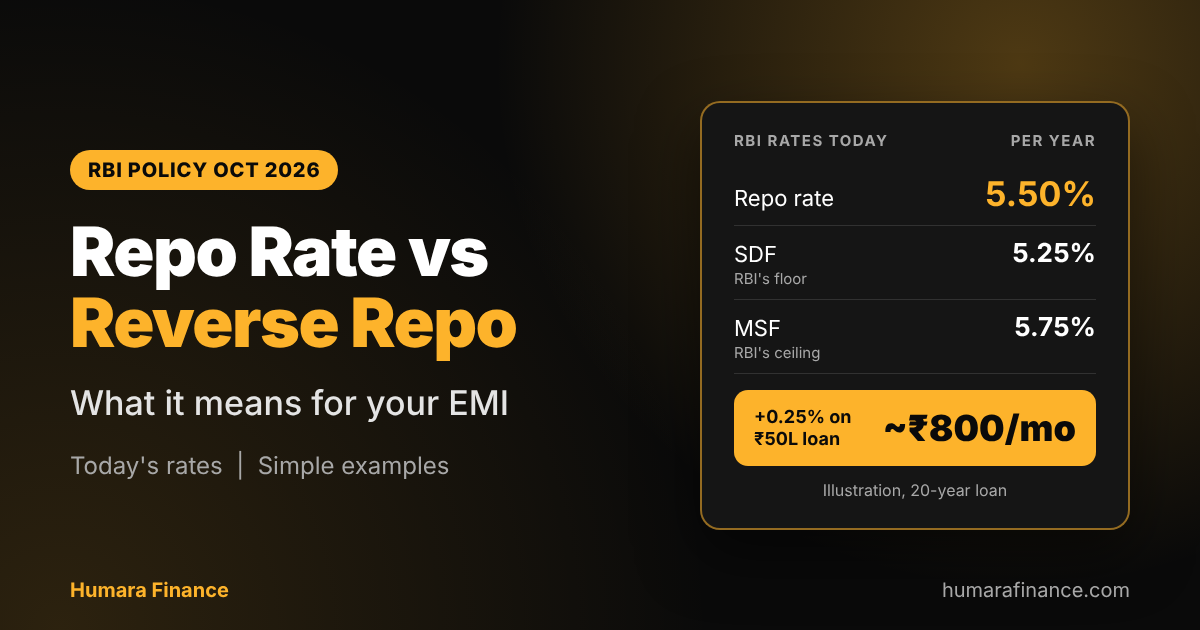
Repo Rate vs Reverse Repo Rate: What It Means for Your EMI
On 7 October 2026, the RBI raised the repo rate to 5.50%. It was the first hike in a while, and within days people were asking whether their home loan EMI would go up. To answer that, you first need to know what the repo rate and reverse repo rate actually are. रेपो रेट क्या है, aur reverse repo se kaise alag hai? Let’s keep it simple.
Table of Contents
ToggleWhat is the repo rate?
Think of the RBI as the bank for banks. When a commercial bank runs short of cash, it borrows from the RBI by selling government securities and agreeing to buy them back later. The interest rate on that loan is the repo rate (“repurchase” rate).
When the repo rate goes up, borrowing becomes costlier for banks. They usually pass some of that on to you through higher loan rates. When it goes down, loans can get cheaper
What is the reverse repo rate?
It’s the opposite. Sometimes banks have too much cash. The RBI can take that cash for a short time and pay the bank interest. That interest rate is the reverse repo rate. The RBI uses it to pull extra money out of the system.
The easy way to remember it: in repo, the RBI lends. In reverse repo, the RBI borrows.
The rates today
| Rate | Level |
|---|---|
| Repo rate | 5.50% |
| Standing Deposit Facility (SDF) | 5.25% |
| Marginal Standing Facility (MSF) | 5.75% |
| Bank Rate | 5.75% |
| Fixed reverse repo rate | 3.35% |
Here’s the part most explainers skip. The fixed reverse repo rate (3.35%) still exists on paper, but it isn’t what the RBI actually uses to absorb cash anymore. Since April 2022 the working floor is the SDF, which sits 0.25 percentage points below the repo rate. The ceiling is the MSF, 0.25 above it. So if the repo rate moves, the SDF and MSF move with it, while the old reverse repo number stays where it is. The 3.35% figure comes from secondary sources, so pls refer RBI website.
Why did the RBI raise the repo rate?
The RBI said inflation and its outlook are not benign. Retail inflation rose to 4.8% in August 2026 from 4.5% in July, and the RBI expects it to average around 5.2% this financial year. It cited a weak monsoon, high energy and commodity prices, and the conflict in West Asia. It also changed its stance to “calibrated tightening”. The vote to raise the rate was unanimous.
Higher rates make borrowing and spending costlier, which helps cool prices.
What it means for your EMI
If your loan is linked to the repo rate (many newer floating-rate home loans are), your rate changes after the hike. Banks reset these on a schedule, so the change shows up within a few months, not on the same day.
Example: a ₹50 lakh home loan for 20 years.
- At 9.00%, the EMI is about ₹44,986.
- At 9.25% (a 0.25% rise), the EMI is about ₹45,793.
- That’s roughly ₹800 more every month, or about ₹9,700 a year.
If your lender keeps your EMI unchanged, it usually extends your loan tenure instead. Ask your bank which one they chose.
What it means for deposits
Banks may also raise FD rates over time when the repo rate goes up, but that’s their decision and it usually happens slowly. If you’re about to book an FD, compare rates across a few banks before you commit.
Mistakes people make
- Thinking reverse repo is higher than repo. It’s lower. The RBI pays less to take your money than it charges to lend it.
- Assuming every loan changes. Fixed-rate loans don’t move when the repo rate does. Check your sanction letter to see whether your loan is linked to the repo rate, the MCLR, or fixed.
- Expecting a cut to drop your EMI at once. The same slow reset applies in both directions.
One thing I’d do: if you have a floating-rate loan and your rate is above what new borrowers get, ask your bank about a rate reduction or switching to a repo-linked rate. Many people never ask.
FAQs
What is the repo rate today?
5.50%, since the RBI’s decision on 7 October 2026.
What is the difference between repo and reverse repo?
Repo is the rate at which the RBI lends to banks. Reverse repo is the rate at which the RBI borrows from banks.
Will my EMI go up after a repo rate hike?
If your loan is linked to the repo rate, yes, after your bank’s next reset. Fixed-rate loans don’t change.
Is the reverse repo rate still used?
The fixed reverse repo rate (3.35%) is still published, but since 2022 the SDF works as the RBI’s actual floor.
When is the next RBI policy meeting?
Check the RBI website for the schedule. Rates can change at any meeting.
This is for educational purposes only, not financial advice. Check your loan agreement and the RBI website for the latest rates.
Sources: